


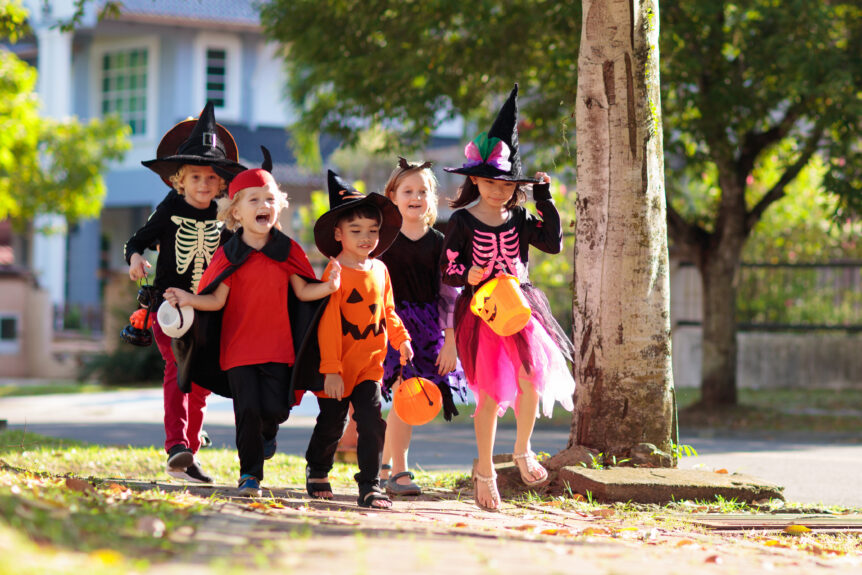
On Halloween night, dozens of strangers walk up your driveway in the dark. Most are kids. Many are wearing masks that block their view and costumes that catch on steps. That makes Halloween one of the busiest nights of the year for your front walk, and a common night for homeowners liability claims.
Here is what your homeowners policy covers if someone gets hurt on your property, and what to check before the 31st.
Does homeowners liability cover a trick-or-treater injury on Halloween?
Yes, and you can be held responsible for the injury. In Massachusetts, property owners owe a duty of reasonable care to anyone lawfully on their property. A lit porch and a bowl of candy is an invitation. If a child trips on a loose paver, slips on wet leaves, or falls on a dark set of stairs, the family can bring a claim against you.
Your homeowners policy responds in two ways:
- Medical payments to others. This pays a guest’s medical bills for minor injuries regardless of who was at fault. Limits are usually modest, often $1,000 to $5,000. It is designed to settle small injuries quickly, before they turn into lawsuits.
- Personal liability. If the injury is serious or the family sues, this coverage pays for your legal defense and any settlement or judgment, up to your policy limit. Many policies carry $100,000 to $300,000.
A broken arm with surgery and follow-up care can approach that lower limit faster than most people expect. If your homeowners liability limit has not changed since you bought the house, check it before Halloween.
Does homeowners insurance cover dog bites?
Halloween decorations create two separate exposures: damage to your own home and homeowners liability for injuries to others. Decorations start an average of 835 U.S. home fires a year, and about a third of those begin with candles, according to the National Fire Protection Association.
Damage to your own home. If a candle in a jack-o’-lantern tips over and starts a fire, the dwelling and personal property sections of your homeowners policy typically cover the damage, minus your deductible.
Injuries to other people. If a costume brushes a lit candle and catches fire, or a visitor trips over an extension cord running to an inflatable, that is a liability claim. The same goes for a heavy decoration that falls onto someone’s car or a neighbor’s property.
A few common sources of trouble:
- Props, gravestones, and hay bales placed where people walk in the dark
- Open-flame candles in pumpkins and luminaries along the walkway
- Extension cords across steps or paths
- Fog machines that hide steps and make surfaces slick
What about decorations, candles, and fire risk?
Decorations can cause two kinds of problems, and your policy treats them differently.
Damage to your own home. If a candle in a jack-o’-lantern tips over and starts a fire, the dwelling and personal property sections of your homeowners policy typically cover the damage, minus your deductible.
Injuries to other people. If a costume brushes a lit candle and catches fire, or a visitor trips over an extension cord running to an inflatable, that is a liability claim. The same goes for a heavy decoration that falls onto someone’s car or a neighbor’s property.
A few common sources of trouble:
- Open-flame candles in pumpkins and luminaries along the walkway
- Extension cords across steps or paths
- Fog machines that hide steps and make surfaces slick
- Props, gravestones, and hay bales placed where people walk in the dark
How do you lower your homeowners liability before Halloween?
Most Halloween injuries come from ordinary hazards that are easy to miss in daylight. Walk your property after dark a few days before the 31st and look at it the way a seven-year-old in a mask would.
- Turn on every outdoor light along the path from the sidewalk to your door
- Rake leaves and clear wet debris from steps and walkways
- Fix loose railings, pavers, and uneven steps, or block them off
- Swap real candles for battery-operated lights
- Tape down or reroute extension cords away from foot traffic
- Move hoses, planters, and lawn equipment out of the path
- Keep pets inside and away from the front door
- If you’d rather skip it, leave the porch light off
Frequently asked questions
Does homeowners liability cover a Halloween party I host?
Generally, yes. Guests at a party are covered under the same personal liability section as trick-or-treaters. Serving alcohol adds risk. In Massachusetts, a host can be held responsible for injuries caused by a guest they served while the guest was visibly intoxicated, and serving minors creates serious exposure. If you host regularly, an umbrella policy adds liability limits above your homeowners coverage.
What if my dog is normally friendly?
It does not change your liability. Massachusetts holds dog owners strictly liable for bites, with narrow exceptions for trespassing or teasing. A friendly dog in an unfamiliar, noisy situation can still react. Keep your dog behind a closed door for the evening.
Do renters have the same liability coverage?
Renters insurance includes personal liability and medical payments coverage that work much like a homeowners policy. Your landlord’s policy covers the building, not you. If a guest is hurt in your apartment or your dog bites a visitor, your own renters policy is what pays. If you don’t have one, Halloween is a good reason to get it.
Not sure what your liability limit is?
Call your account manager before the 31st. We’ll pull your liability limit, check for dog exclusions, and tell you whether an umbrella makes sense for your household.